
Loading...
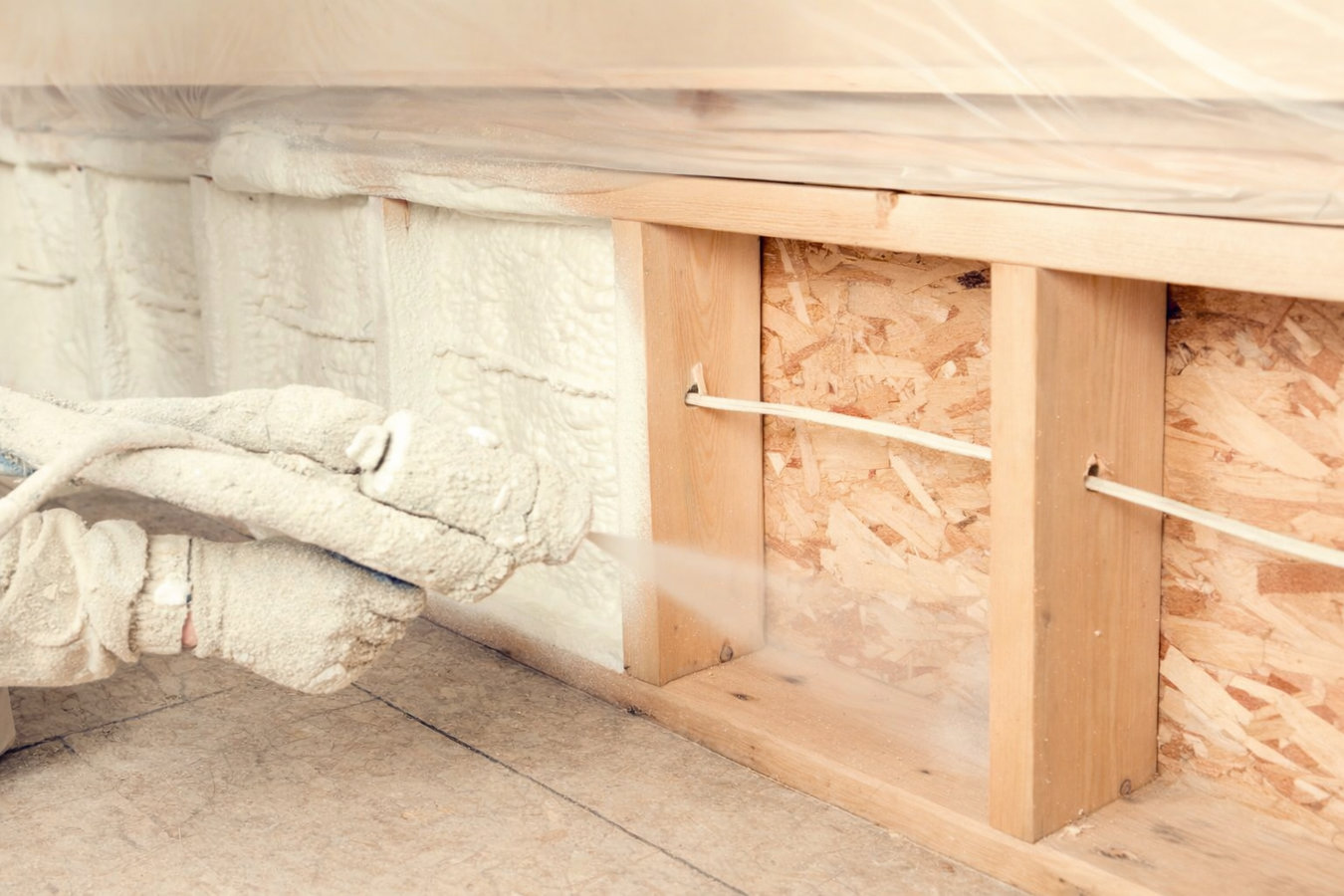
The most effective insulation for Wisconsin crawl spaces and rim joists - closes air gaps and blocks moisture in a single application.
Closed-cell foam insulation in Eau Claire is a spray-applied material that expands on contact, hardens into a rigid layer, and seals air gaps at the same time it insulates - most residential jobs take one to two days from start to finish. It delivers roughly twice the insulating resistance per inch compared to fiberglass batts, which matters a lot when you have limited space in a crawl space, rim joist, or knee wall.
Most insulation slows heat from passing through walls, but closed-cell foam does something extra: it seals the small gaps and cracks where cold air sneaks in. In an Eau Claire winter, those air leaks are often responsible for more heat loss than the wall surfaces themselves. Many homeowners choose closed-cell foam specifically for crawl spaces and rim joists, then pair it with open-cell foam insulation in larger attic areas where budget allows.
Homes built before the 1980s in Eau Claire neighborhoods like Randall Park and the Emery Street corridor often have rim joists with no insulation at all - and that single area can account for a significant share of a home's total heat loss. Closed-cell foam is the most direct fix for that problem.
If your gas or electric bill climbs every November and stays high through March even after your furnace has been serviced, the problem is likely heat escaping through under-insulated areas. In Eau Claire's climate, a poorly insulated crawl space or rim joist can account for a surprising share of your home's total heat loss.
Cold drafts at floor level - especially in rooms above a crawl space or unheated basement - are a classic sign that cold air is entering from below. In older Eau Claire homes, the rim joist is often completely uninsulated and full of small gaps. Running your hand along the baseboard on a cold day is a simple test: if it feels noticeably cooler than the rest of the wall, that area needs attention.
Eau Claire's cold winters and wet springs create ideal conditions for moisture to accumulate in uninsulated crawl spaces. If you have ever peeked under your home and seen frost on the framing, water stains on the wood, or smelled something musty, those are signs that moisture is getting in and the space is not sealed. Left alone, this leads to mold and wood rot that costs far more to fix than insulation.
Homes built before the early 1980s were constructed under much looser energy standards than exist today. If you have lived in your Eau Claire home for years and cannot recall any insulation work being done, there is a reasonable chance the crawl space, rim joist, and attic are underperforming - and a quick assessment by a local contractor can confirm it at no cost.
Closed-cell foam is most commonly used in specific high-impact areas rather than as a whole-house solution. The three most common applications in Eau Claire are crawl spaces, rim joists, and attic knee walls - all spots where a thin, dense layer of foam delivers an outsized improvement in both comfort and energy use. The foam expands within seconds of application, fills irregular gaps that batt insulation cannot reach, and cures to a rigid layer that will not sag or settle over time. For broader whole-home projects, we often recommend starting with closed cell spray foam in the below-grade and rim joist areas, then addressing the attic and walls with spray foam insulation as part of a phased approach.
The material is also a strong choice for older homes where moisture is a concern. Unlike fiberglass batts - which can absorb moisture and lose performance - closed-cell foam resists water vapor from passing through walls. That dual function is one reason it is recommended so often for Eau Claire basements and crawl spaces. If you are also considering whole-home air sealing, we can pair closed-cell foam work with broader open-cell foam insulation in areas where the higher density is not needed.
Seals moisture and insulates in one pass - the highest-impact upgrade for most older Eau Claire homes with a crawl space.
Fills the most air-leaky zone in pre-1980 homes - small gaps around the framing that sits on top of your foundation wall.
Ideal for homes with finished attic space or pull-down stairs where air leakage from the attic is pulling heat out of the living space.
Best for older Eau Claire homes near river corridors where basement walls see seasonal moisture pressure every spring.
Eau Claire sits in a climate zone where Wisconsin's energy code requires higher insulation levels than most of the country. Average January lows drop into the single digits and wind chills can push well below zero for weeks at a time. A contractor who knows local requirements will spec the job correctly from the start - and one who does not may leave you with a home that still feels cold and costs too much to heat. Much of the residential housing stock in Eau Claire dates from the mid-20th century or earlier, when insulation was minimal by today's standards. Older homes in neighborhoods like Randall Park often have little to no insulation in their crawl spaces, rim joists, or knee walls - exactly where closed-cell foam makes the biggest difference.
Eau Claire also experiences repeated freeze-thaw cycles through late fall, winter, and early spring. In crawl spaces and rim joists, this cycling can drive moisture into uninsulated framing, leading to mold, rot, and structural damage over time. Closed-cell foam's moisture-blocking properties make it particularly well-suited to these areas in Eau Claire homes. We serve homeowners throughout the region, including Menomonie and Osseo, where the same climate and housing stock conditions apply.
Call or submit a request online and we will get back to you within one business day. Let us know what you are hoping to address - cold crawl space, drafty basement, high heating bills - so the estimator can come prepared.
We visit your home to look at the areas you want insulated, check existing insulation, and look for moisture issues that should be addressed first. You receive a written estimate that explains what we are recommending and why - no pressure, no obligation.
For most projects in Eau Claire that add insulation to a previously uninsulated space, we apply for a building permit before work begins. This typically takes a few business days. Once the permit is in hand you get a confirmed installation date.
The crew arrives, sets up protective coverings, and sprays the foam in layers. A crawl space or rim joist job often wraps in a few hours. Plan to stay out of the home for 24 hours after spraying. After the city inspector signs off, the job is complete.
Free estimate, written quote before any work begins. No obligation and no sales pressure.
(534) 400-0045We pull building permits from the City of Eau Claire when a job requires one and schedule the city inspection so the work is verified against Wisconsin energy code. You get a documented record of every project before and after we do it.
We work on homes throughout Eau Claire and the Chippewa Valley region - from bungalows near downtown to 1960s ranch homes on the south side. Local experience means we know the moisture patterns, housing stock, and permit process in this area.
Eau Claire homeowners served by Xcel Energy or Eau Claire Energy Cooperative may be eligible for cash rebates through Wisconsin's Focus on Energy program. We help customers understand what they qualify for before the project starts so they are not leaving money on the table.
According to the{' '} Spray Polyurethane Foam Alliance, proper mixing ratios and application temperatures are critical to foam performance. Our crew is trained on those standards - which is why the foam we apply cures correctly and insulates the way it should for years to come.
Every closed-cell foam project we complete is permitted and inspected - giving you documentation that the work meets Wisconsin's energy standards and protecting your home's value when it comes time to sell.
A softer, more affordable foam option well-suited for interior walls and large attic areas where moisture vapor permeance is acceptable.
Learn moreThe broader category that covers both open- and closed-cell options - learn which type of spray foam is right for each area of your home.
Learn moreBook your free estimate today - spray foam crews fill up fast before the heating season and waiting means another winter of preventable heat loss.